
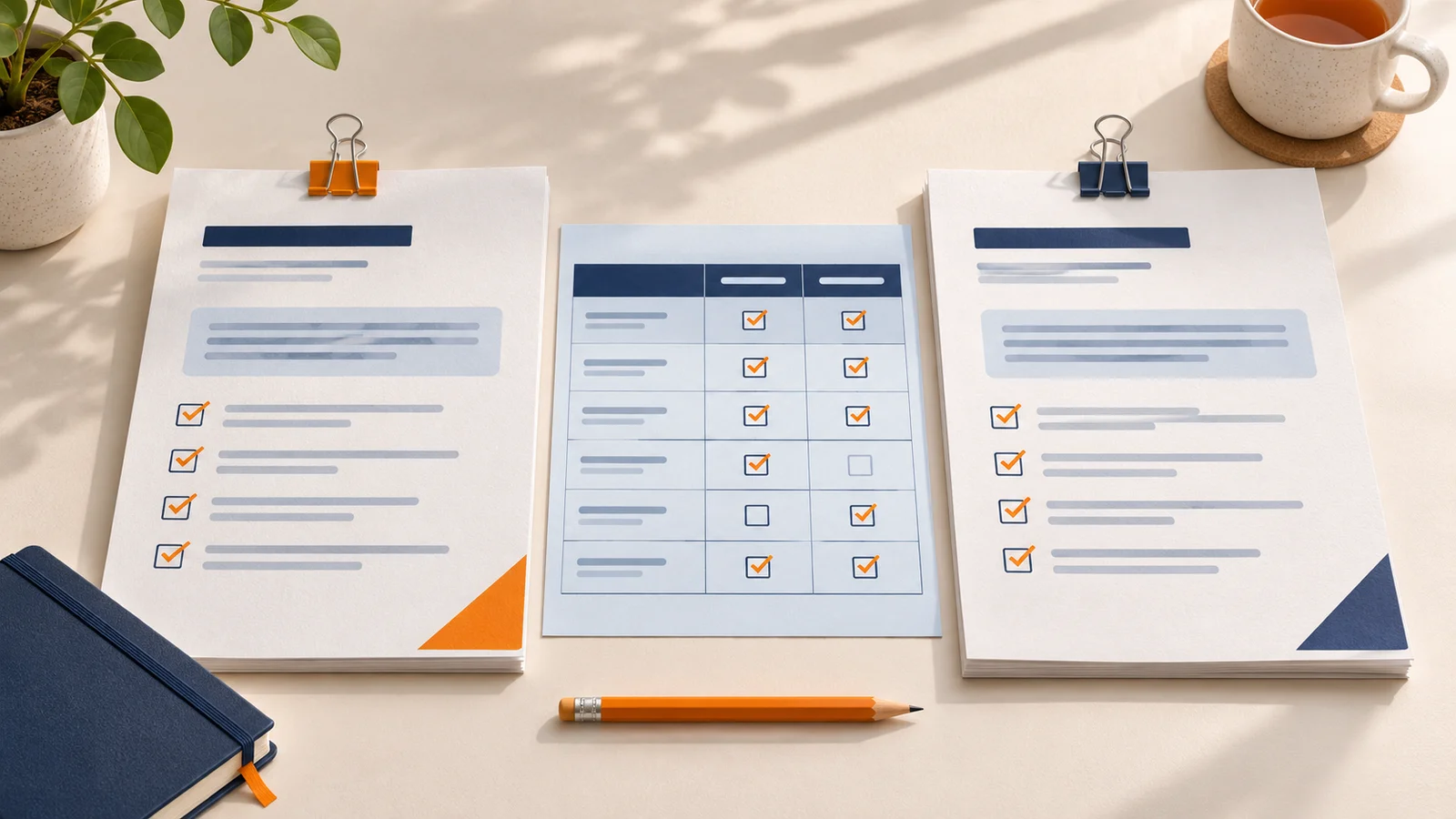
Before comparing two software proposals, check whether both describe the same work. Put scope, acceptance conditions, third-party costs and post-launch support side by side. Then ask each vendor how it will build, test and hand over a critical user journey. Evaluate the price in light of those answers.
Start by putting both proposals on the same footing
Send both vendors the same brief. Who will use the application, how is the work done today, and what should the first release achieve? Attach a sample form, a screenshot of the current system or anonymised sample data if available. If details are unknown, say so and ask each vendor to document its pricing assumptions.
‘Customer portal, admin dashboard and ERP integration’ names three components. Describe how they should behave. Can a customer view and approve a quote? Does a price change require fresh approval? Will the record wait if the ERP connection drops? Will historical records migrate? A proposal that includes migration delivers something quite different from one that integrates only new records.
Mark migration, reports, training, mobile design, third-party integrations and the test environment as included, excluded or unclear. Resolve unclear items in writing. If vendors propose different approaches, ask both to explain their assumptions and business impact so good alternatives get a fair hearing.
Software proposal comparison table
Copy this table into a spreadsheet. Record each vendor’s written answer and the relevant proposal page. Ask for clarification when a critical row is unanswered. If you plan to score proposals, set priorities beforehand. Where live data must be migrated, that requirement still stands even if the price is lower or the start is sooner.
| Criterion | Same question for vendor A and vendor B | Evidence to look for |
|---|---|---|
| Scope | Which workflows, roles and integrations will work in the first release? | Written list of inclusions and exclusions. |
| Schedule | What can we see by which date, and what is that date contingent on? | Interim deliverables, client inputs and dependencies. |
| Acceptance and testing | How will we know the work has been delivered? | Critical scenarios, test environment and acceptance owner. |
| Total cost | What makes up development, integration and running costs? | Breakdown of one-off and recurring costs and usage assumptions. |
| Handover | What files and accounts can a successor team access? | Plan for repository, installation guide, data export and account access. |
| Post-launch | Who handles defects? How are new requests priced? | Support scope, response targets and change request process. |
| Comparable work | How have you handled this risk or workflow before? | Demonstration of a similar project, the vendor’s role and the challenges it faced. |
Worked example: which proposal actually costs less?
Suppose a business gets two quotes to digitise its proposal and approval processes. Both vendors build the same core screens. Vendor A prices integration and migration of historical data separately. Vendor B includes both up front. The figures are fictional. Both estimates cover the same six months of post-launch running costs and exclude tax.
| Item | Vendor A | Vendor B |
|---|---|---|
| Development | 180,000 | 220,000 |
| Integration | 35,000 | Included |
| Data migration | 20,000 | Included |
| Six months of operation | 24,000 | 12,000 |
| Total | 259,000 | 232,000 |
Vendor A initially looks TRY 40,000 cheaper. With matching scope and six months of operation, vendor B costs TRY 27,000 less in total. Compare actual proposals over the same time period and usage volume. Model changes in licensing, hosting or messaging costs separately if doubling the number of users affects them. Mark unpriced items ‘awaiting confirmation’.
A fixed price can give budget visibility when scope and delivery terms are clear. Time and materials can make it easier to shift priorities when uncertainty is high. In either model, get the spending cap, priorities and approval for scope changes in writing. If integration or legacy-data risks are hard to estimate, price a separate discovery phase with defined scope and deliverables.
What to look for when choosing a software vendor
Meet the delivery team during the sales call
Who runs the project and makes technical decisions? How is knowledge transferred if a team member leaves or moves to another project? I would ask someone from the delivery team to join the call and explain a decision from a similar project. Screenshots show design. The team’s role becomes clearer when it can explain which integration it owned, what it tested and what issue it handled after launch.
Walk through one user journey end to end
Choose the most critical workflow for the first release. For example, a quote is prepared, the customer requests changes, then approves the final version. Ask the vendor to describe success, failure, retries and who sees the outcome. This makes test coverage concrete. Knowing who signs off and what evidence they need also reduces pressure to ‘just push it live’ later. Testing and go-live decisions in software
Clarify post-launch ownership and handover
Launch day can mark the start of the work. Who owns the server and external service accounts? Who takes bug reports? How are dependency updates, routine maintenance and new features handled? Get repository access, data export, installation documentation and handover steps in writing at proposal stage. ‘Code is included’ says little about restoring a working installation.
Ask for an updated written proposal
Send both finalists the same list of open items. Ask each for the acceptance criteria and cost assumptions behind its update. Consider clarity alongside speed. Ask what ‘yes, included’ means in terms of a specific deliverable. Base your decision on what the vendor says, what it commits to in writing and what you can verify.
A quick check before you decide
- Are you comparing the same first release, user workflows and integrations?
- Are one-off and ongoing costs calculated over the same period?
- Are the delivery team, milestones and acceptance evidence clear?
- Are post-launch support, account access and handover to another team documented?
Frequently asked questions
How many software proposals should I get?
Two or three proposals with similar scope can be enough to start. If the figures are all over the place, send the same brief and request fresh quotes.
What if two software proposals are far apart on price?
Align first-release scope, migration, licensing and running costs, tests and post-launch support. If the gap persists, ask in writing about the team, time estimate and underlying assumptions.
What extra costs can come up after the proposal?
Data cleaning and migration, integrations, third-party licences, hosting, messaging and maintenance are often overlooked. Ask for one-off and usage-based fees separately.
How do I specify source code and account handover?
List the repository access, code and documents to deliver, infrastructure accounts, data exports and installation steps by name. Ask about the terms for any third-party components.
How do I check a software vendor’s references?
Ask for a current demo of a comparable project, what the vendor owned and how the system was operated after launch. Where possible, with the vendor’s and client’s permission, speak to the person responsible for the project.
Can I get a technical review before starting a software project?
Yes. Share your project needs and open items from the proposals. We can review scope, delivery criteria, integration assumptions and cost items together.